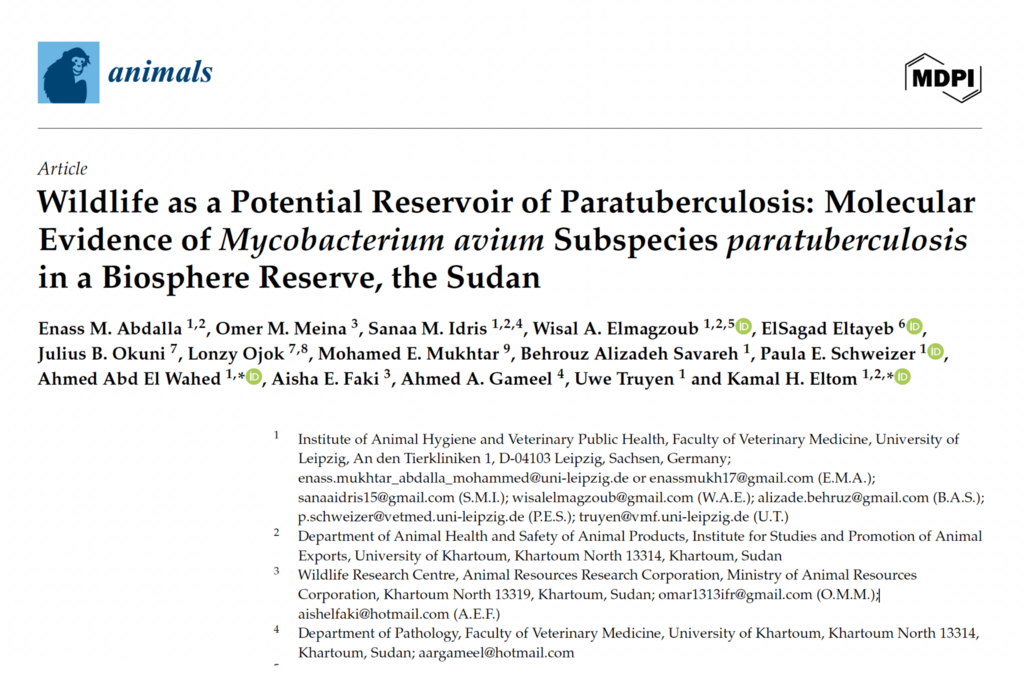
A new peer-reviewed study in the open-access journal Animals has used Xpedite's SwiftX™ DNA extraction kit to generate the first molecular evidence of Mycobacterium avium subsp. paratuberculosis (MAP) in wildlife in Sudan, and one of the first such surveys anywhere in Africa.
Working in Dinder National Park, one of Africa's largest biosphere reserves, the research team screened 274 non-invasive faecal samples from five wild ungulate species. Using rapid SwiftX™ DNA extraction followed by an isothermal amplification assay, and without a conventional laboratory, they detected MAP DNA in 37.9% of samples, a true detection rate of 42.4%, across every species sampled.
The study is a clear demonstration of what rapid, field-ready sample preparation makes possible: molecular disease surveillance in exactly the settings where it is hardest, with no fixed infrastructure and no animal capture required. It is precisely the decentralized, point-of-need workflow that SwiftX™ chemistry is designed to enable, whether the target is a wildlife pathogen, a bloodstream infection, or an environmental sample.
We were not involved in the study; our SwiftX™ DNA kit was used by the authors for sample preparation.
Read our full write-up of the study, Is paratuberculosis circulating in African wildlife?, or access the original open-access paper in Animals.