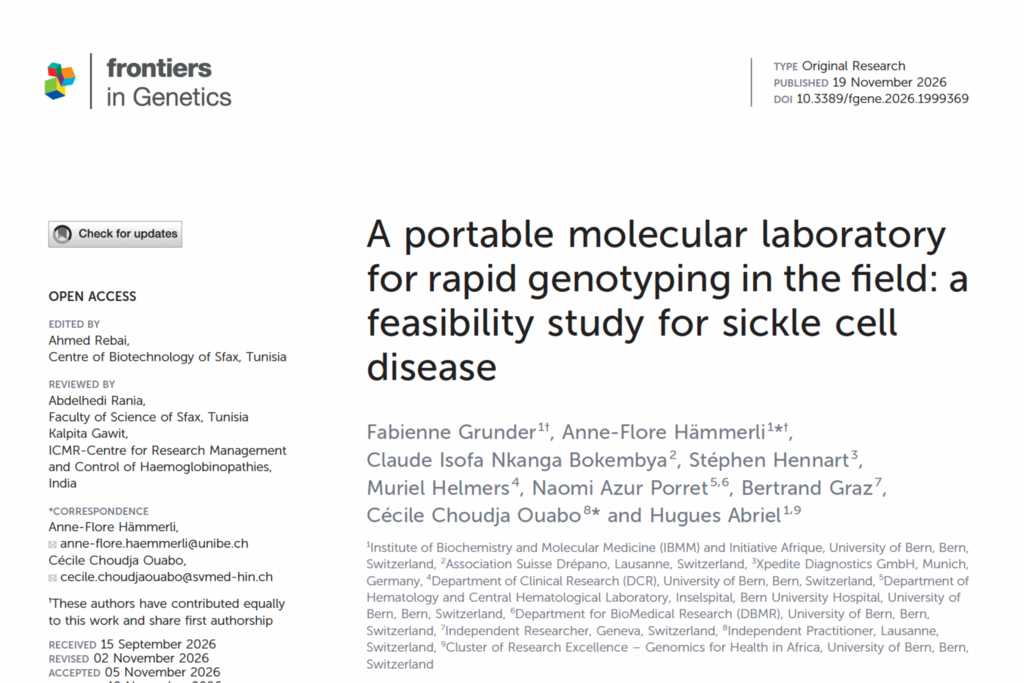
A new peer-reviewed study in Frontiers in Genetics used Xpedite’s portable molecular laboratory to genotype 27 participants for sickle cell disease on site, from buccal swabs and dried blood spots, with initial results within five hours. No fixed laboratory was required.
A new peer-reviewed study in the open-access journal Frontiers in Genetics shows that HBB genotyping for sickle cell disease can be performed outside a conventional laboratory. It used a portable molecular laboratory that Xpedite co-developed with the University of Bern.
The two-suitcase laboratory was set up in a hotel meeting room in Lausanne, at the annual meeting of the Association Suisse Drépano. There, the research team genotyped 27 participants for the HbA, HbS and HbC alleles from paired buccal swabs and dried blood spots, using a CE-IVD loop-mediated isothermal amplification (LAMP) assay. Initial results were available within five hours of sample collection. Buccal swabs and dried blood spots agreed for 23 of 26 comparable participants (88.5%) at first pass, and for all 26 after repeat testing. This is the first reported use of buccal swabs with this assay.
Sickle cell disease affects around 7.7 million people worldwide, most of them in sub-Saharan Africa, where access to molecular diagnosis remains limited. The study shows that a medical genetics workflow can run in a real community setting within a single day. It is the infrastructure-independent model the portable laboratory is designed for: a self-contained case with its own workbench, instrumentation and power supply, able to operate from a car battery. As a feasibility study, it did not assess diagnostic accuracy. Validation in endemic, resource-limited settings is the next step.
The portable laboratory was developed by Xpedite in collaboration with Prof. Hugues Abriel’s group at the University of Bern, and Xpedite’s Stéphen Hennart is a co-author of the study. We congratulate all the authors and thank the participants from the Association Suisse Drépano.
Access the original open-access paper in Frontiers in Genetics.